
Ready to print
You have already purchased this music, but not yet printed it.
This page is just a preview and does not allow printing. To print your purchase, go to the My purchases page in your account and click the relevant print icon.
Emperor Waltz
Already purchased!
You have already purchased this score. To download and print the PDF file of this score, click the 'Print' button above the score. The purchases page in your account also shows your items available to print.
This score is free!
Buy this score and parts
Emperor Waltz

$23.70
$9.95
from $2.75
Preview individual parts:

Instant download
You are purchasing high quality sheet music PDF files suitable for printing or viewing on digital devices.Vienna, the waltz, and the Strauss family are inseparable entities. The waltzes of Johann Strauss, Sr. (1804-49) evoked the air of the Viennese countryside, beer gardens and Heurigen. Those of his eldest son, Johann, Jr., at first had the same rhythmic vitality and brief melodies. After 1860, however, this would change. The younger Strauss infused the traditional waltz format and sound with a new vitality and sophistication that reflected the glittery, hedonistic spirit of 19th-century imperial Vienna. He melded the rhythmic drive of his father's works with Joseph Lanner's (1801-43) lyricism, and changed the rhythmic emphasis from the beat to the measure. Strauss's seemingly unlimited melodic invention prompted him to compose melodies that did not fall into the traditional four, eight, or sixteen-measure patterns of earlier waltz tunes. He maintained the basic outline employed by Lanner and his father: a slow introduction, (typically) five pairs of waltzes and a coda, but increased the length of each section and the organic unity of the whole. Strauss's orchestration is often picturesque, especially in his introductions, while that of the waltzes themselves approaches a Mozartean clarity.
In the Kaiser-Walzer, op. 437, Strauss is thinking as much in terms of the concert hall as the dance hall. It is not possible to waltz to the music of the coda, and the arrangement and patterns of repetition of the waltzes seem to be conceived to satisfy the listener as well as the dancer. The work was published in Berlin in 1889.
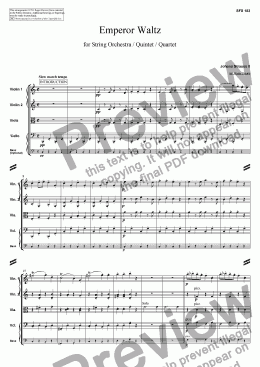
This arrangement plays back a little strangely in the middle due to not performing a DS sign. It comes with an additional third violin part, and an optional bass part for use with string orchestra.

