
You are here: Home > Orchestra > Franzosisches Lied: Est-ce Mars? for String Orchestra
Buy this score now!
Price: $7.50
(+ VAT at 20% when applicable)
Add to basket

You are purchasing a high quality PDF file suitable for printing. More details.

Already purchased!

You have already purchased this score. To download and print the PDF file of this score, click the 'Print' button below.

The purchases page in your account also shows your items available to print.

This score is free!

This score is available free of charge. Just click the print button below.

Franzosisches Lied: Est-ce Mars? for String Orchestra
Composer Samuel Scheidt arranged by Keith Terrett
Arranger Keith Terrett
Publisher Music for all Occasions
Difficulty Moderate (Grades 4-6)
Duration 6 minutes
Genre Classical music
Instrumentation Orchestra
Instrumental parts
Related scores
Czardas for Violin & Small Orchestra, Fanfare & Soliloquy for Violin & Piano, Twenty Minute Tango for Double Bass & Piano (F minor), What Shall We Do With The Drunken Double Bassist?, What Shall We Do With The Drunken String Orchestra?, Italian National Anthem (Inno di Mameli-Mameli Hymn) for String Orchestra, The Jasmine Flower for solo Violin & Piano, Times lost for Cello & Piano, Lustpiel Overture for String Orchestra, Chinese National Anthem for String Orchestra, Czardas for Cello & Piano, Times Lost for Violin & Piano, Vesti La Giubba for Viola & Piano, 7 Popular carols in Norway for two Violins, Vesti La Giubba for Cello & Piano, A Violinist Goes Ballroom Dancing (D minor version), M'Appari Tutt' Amor for Viola & Piano, Arioso (Sinfonia to Cantata Ich steh mit einem Fuß im Grabe) for Viola & Harpsichord, Arioso (Sinfonia to Cantata Ich steh mit einem Fuß im Grabe) for Cello & Harpsichord, What Shall We Do With The Drunken Cellist?, Twenty Minute Tango for Double Bass & Piano (G minor), Quando me'n vo for Violin & Piano, Allegro from Trumpet Concerto for Cello & Keyboard, Vesti La Giubba for Violin & Piano, Bollywood Tango for Violin, Cello & Keyboard, Mattinata for Violin & Piano, Mattinata for Cello & Piano, M'Appari Tutt' Amor for Violin & Piano, O Mio Babbino Caro for Viola & Piano., O Mio Babbino Caro for Violin & Piano, Twenty Minute Tango for Violin & Piano, Overture from Suite in D (Water Music) for two Cello's & Keyboard, Twenty Minute Tango for Flute & Piano, Swing Low, Sweet Chariot for solo Viola & Keyboards, Welsh National Anthem for String Orchestra (Land of my Fathers), Two Arias for String Orchestra, Eight Christmas Carols for Cello & Keyboard, A Serenade for Cello & Keyboard, Solveigs sang for Double Bass & Keyboard, Down by the Salley Gardens(Orchestra), German National Anthem for String Orchestra, Swedish National Anthem for String Orchestra, Polish National Anthem for String Orchestra (World National Anthem Series), Allegro from Torelli’s Concerto (Tpt & Strgs) for Violin & Keyboard’s (1st Mvt), Traumerei for solo Cello & Piano, Papua New Guinea National Anthem for String Quartet & Voice, Nessun Dorma for Viola & Piano, Largo from Concerto in D Major for Lute, RV. 96 for String Orchhestra, Czardas for Viola & Pianoforte, Fugue on B-a-c-h for String Orchestra, What Shall We Do With The Drunken Viola Player?, Badinerie from Suite No.2 for Violin & Piano, Badinerie from Suite No.2 for Double Bass & Piano in E minor (Pro-version), Badinerie from Suite No.2 for Double Bass & Piano in D minor (lower version) and Arioso (Sinfonia to Cantata Ich steh mit einem Fuß im Grabe) for Double Bass & Keyboard
Share
MP3 file

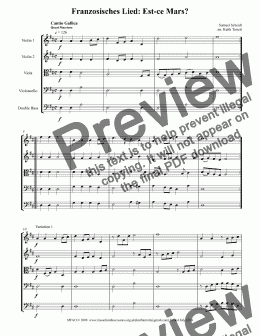
Franzosisches Lied arranged for String Orchestra.

This arrangements makes a challenging work for your strings, who should relish the rich sonorities of Scheidt’s intricate tapestry.

Scheidt was born in Halle, and after early studies there, he went to Amsterdam to study with Sweelinck, the distinguished Dutch composer, whose work had a clear influence on Scheidt's style. On his return to Halle, Scheidt became court organist, and later Kapellmeister, to the Margrave of Brandenburg. Unlike many German musicians, for example Heinrich Schütz, he remained in Germany during the Thirty Years' War, managing to survive by teaching and by taking a succession of smaller jobs until the restoration of stability allowed him to resume his post as Kapellmeister. When Samuel Scheidt lost his job because of Wallenstein, he was appointed in 1628 as musical director over three churches in Halle, including the Market Church.

Scheidt was the first internationally significant German composer for the organ, and represents the flowering of the new north German style, which occurred largely as a result of the Protestant Reformation. In south Germany and some other countries of Europe, the spiritual and artistic influence of Rome remained strong, so most music continued to be derivative of Italian models. Cut off from Rome, musicians in the newly Protestant areas readily developed styles that were much different from those of their neighbors.

Scheidt's music is in two principal categories: instrumental music, including a large amount of keyboard music, mostly for organ; and sacred vocal music, some of which is a cappella and some of which uses a basso continuo or other instrumental accompaniment. In his numerous chorale preludes, Scheidt often used a "patterned variation" technique, in which each phrase of the chorale uses a different rhythmic motive, and each variation is more elaborate than the previous one, until the climax of the composition is reached. In addition to his chorale preludes, he wrote numerous fugues, suites of dances (which were often in a cyclic form, sharing a common ground bass) and fantasias.

Which method of viewing music should I use?

Score Exchange has two methods of display previews of music: seView which uses regular html and javascipt and the Scorch plug-in from Avid which needs to be downloaded and installed onto your computer. Both have advantages and disadvantages:

seView

seView, is the most compatible option. You should be able to view music on all modern web browsers including most mobile devices. Even if your device does not support javascript you should still be able to preview at least page one of the music.

You do not need to install any additional software to use seView.

Scorch

Scorch is a free plug-in from Avid for displaying and printing music. It can also play the music that you're seeing. Scorch generally works well if you're using a windows computer, but is currently not compatible with modern Mac computers or mobile devices.

If your web browser does not install Scorch automatically, you can click here to download and install scorch manually.

TRANSPOSEDMSG
SCORCHPLUGIN

This score was submitted by Keith Terrett. If you wish to perform, record, or broadcast this music then you should contact them first.

In order to submit this score to ScoreExchange.com Keith Terrett has declared that they own the copyright to this work in its entirety or that they have been granted permission from the copyright holder to use their work. If you believe that this score should be not available here because it infringes your or someone elses copyright, please report this score using the copyright abuse form.

This score has instrumental parts available to purchase. Would you like to add a set of parts to your basket as well as the score?
Select Name Price
Total:
(Prices exclude VAT at 20% where applicable)

The PDF of this score should start downloading automatically, or alternatively click the download button below, or use this link to download the pdf.

Up
Down
website by ADAP Solutions Ltd
Visa, Mastercard, Maestro, Electron, Delta, Solo logos - powered by PayPoint.net
Powered by Sibelius Scorch